

Studio post · August 28, 2026

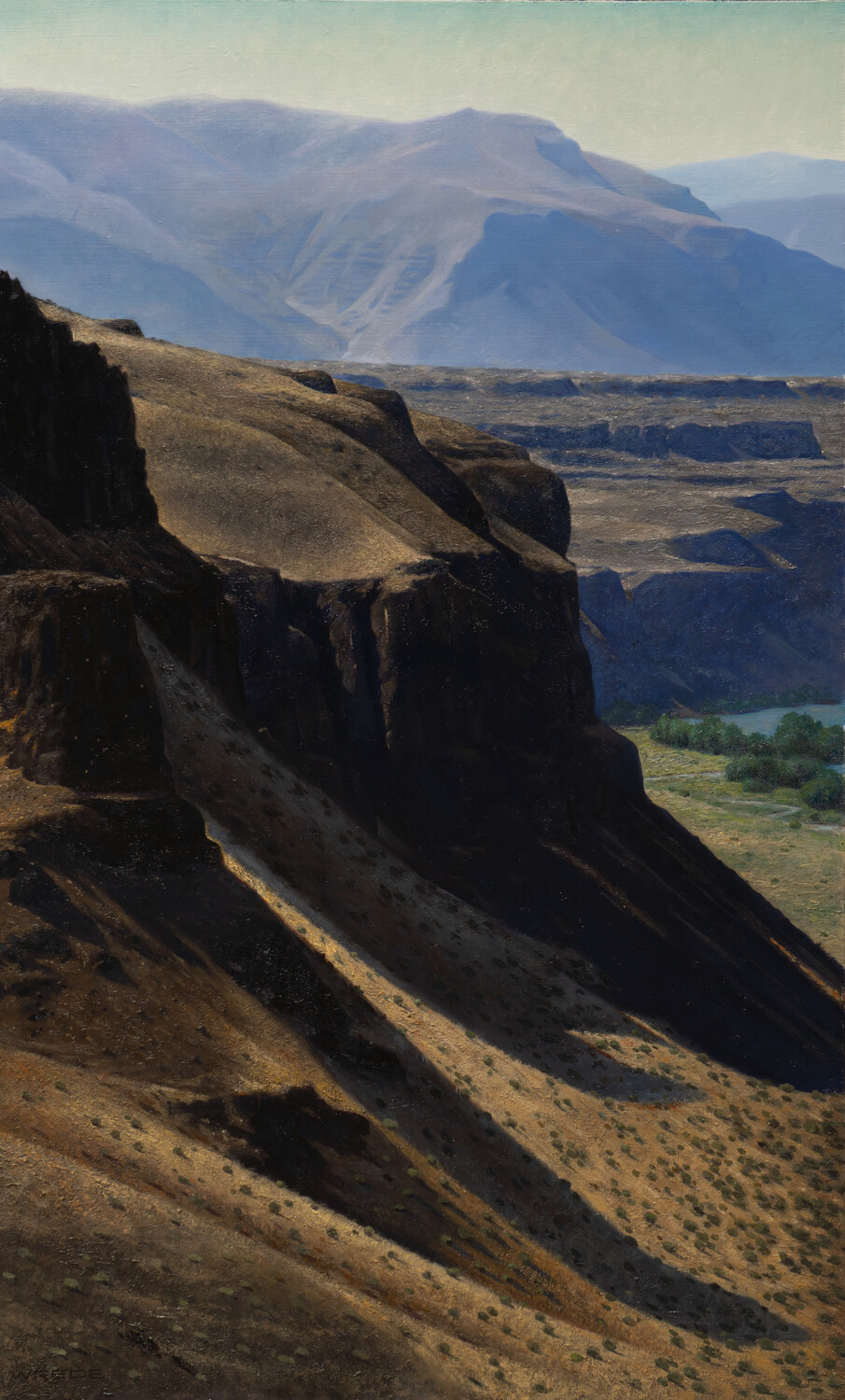
Last week I finished another painting from my year at the Seattle Prize—this one inspired by the landscape along the Columbia River in central Washington. Every time I cross the Cascade Mountains and enter the dry region far east of Seattle, I’m struck by the immense scale of the landscape. It is a place that makes human life feel very small. The cliffs, coulees, exposed rock, and broad stretches of open country are reminders that we occupy only a brief moment in a geological story unfolding over millions of years. I find that change in perspective valuable, perhaps especially in 2026, when so much of our attention is consumed by the immediate. The Columbia River adds another dimension to that story. It is one of the great natural forces of the Pacific Northwest, beginning in the mountains of British Columbia and traveling more than a thousand miles before reaching the Pacific Ocean. Yet the river we encounter today is also profoundly shaped by human intervention. A series of enormous dams has transformed much of its historic character, harnessing its power and altering the landscape around it. There is something fascinating about that tension between forces far greater than ourselves and our remarkable ability to reshape them. The country surrounding the Columbia bears evidence of even older and more powerful transformations. Much of central and eastern Washington was shaped by ancient volcanic activity, erosion, and the catastrophic Ice Age floods that tore across the region thousands of years ago. The strange forms we see today are, in a sense, scars left behind by deep time. That is what drew me to this particular landscape and ultimately to painting it. Much of this country lies only a few hours from Seattle, yet I suspect many people have little idea how extraordinary it is. One of my ambitions as a landscape painter is simply to make people stop and look again. Places we drive past or take for granted can become astonishing when we give them our full attention. With this painting, I wanted to celebrate the scale, strangeness, and spectacle of this remarkable corner of Washington, and perhaps offer a small reminder of just how much existed before us and how much will remain after we are gone.